
Have you ever picked up a medicine and felt confused by all the information printed on its box or bottle? You are not alone. Medicine labels often contain unfamiliar words, abbreviations and instructions in very small print.
However, taking a few minutes to read the label can help you avoid common mistakes. It tells you what the medicine contains, how much you should take, when to take it and whether there are any important warnings.
Knowing how to read medicine labels is a simple but valuable habit for everyone. Let us look at each part of a medicine label and understand what it means.
Why Should You Read the Medicine Label?
Many people read only the name on the front of the package. Once they recognise the product, they take it without checking the remaining information. Although the medicine may look familiar, its strength, ingredients or instructions could be different.
Reading the complete label helps you confirm that:
- You have picked up the correct medicine.
- The medicine is meant for your health problem.
- You are taking the correct amount.
- The product has not expired.
- It does not contain an ingredient you should avoid.
- You know about its possible side effects and warnings.
- You are storing it correctly.
This becomes even more important when you are taking more than one medicine. Two different products can sometimes contain the same active ingredient. Taking both products together may accidentally give you more than the recommended amount.
Start With the Medicine’s Name
The first thing you will usually notice is the medicine’s brand name. It is often printed in large letters on the front of the package.
You may also see another name written below it. This is usually the generic name or the name of the active ingredient. While different companies can sell a medicine under different brand names, the active ingredient may be the same.
Before using any medicine, check both names carefully. If your pharmacist gives you a product that looks different from the one you normally use, do not immediately assume it is incorrect. The packaging or manufacturer may have changed.
Still, it is always sensible to ask the pharmacist if you are unsure.
Find the Active Ingredient
The active ingredient is the substance that produces the medicine’s intended effect. You can normally find it under headings such as “Composition,” “Ingredients” or “Each tablet contains.”
For example, the label may tell you how much active ingredient is present in each tablet, capsule or 5 ml of syrup.
Checking this information is important because two medicines made for similar symptoms may contain the same ingredient. This commonly happens with products intended for pain, fever, cough or cold symptoms.
Do not judge a medicine only by the colour or size of its tablet. Always read the actual ingredient information.
Understand What the Medicine Is Used For
The label may include a section called “Uses,” “Indications” or “Purpose.” This section explains which symptoms or health conditions the medicine is designed to treat.
Read it before taking an over-the-counter medicine. Do not use a product for a different problem just because someone else found it helpful.
Prescription medicines should only be used by the person for whom they were prescribed. Never share them with a friend or family member, even when that person appears to have the same symptoms.
Similar symptoms can have very different causes. A healthcare professional can decide whether a particular treatment is suitable.
Read the Dosage Instructions Slowly
Dosage instructions tell you how much medicine to take and how often to take it. This is one section where you should never guess.
Look for answers to the following questions:
- How much should I take at one time?
- How many times can I take it in one day?
- How much time should I leave between doses?
- Should I take it before or after food?
- Is the dose different for adults and children?
- For how many days should I use it?
- What is the maximum amount allowed in 24 hours?
Taking more medicine does not necessarily mean that you will recover faster. Instead, it may increase the chance of side effects or cause serious harm.
If you forget to take a dose, do not automatically double the next one. Read the patient-information leaflet or ask your doctor or pharmacist what to do.
When using a liquid medicine, measure it with the cup, spoon or oral syringe provided with the product. A regular kitchen spoon may hold more or less than the correct amount.
Take the Warnings Seriously
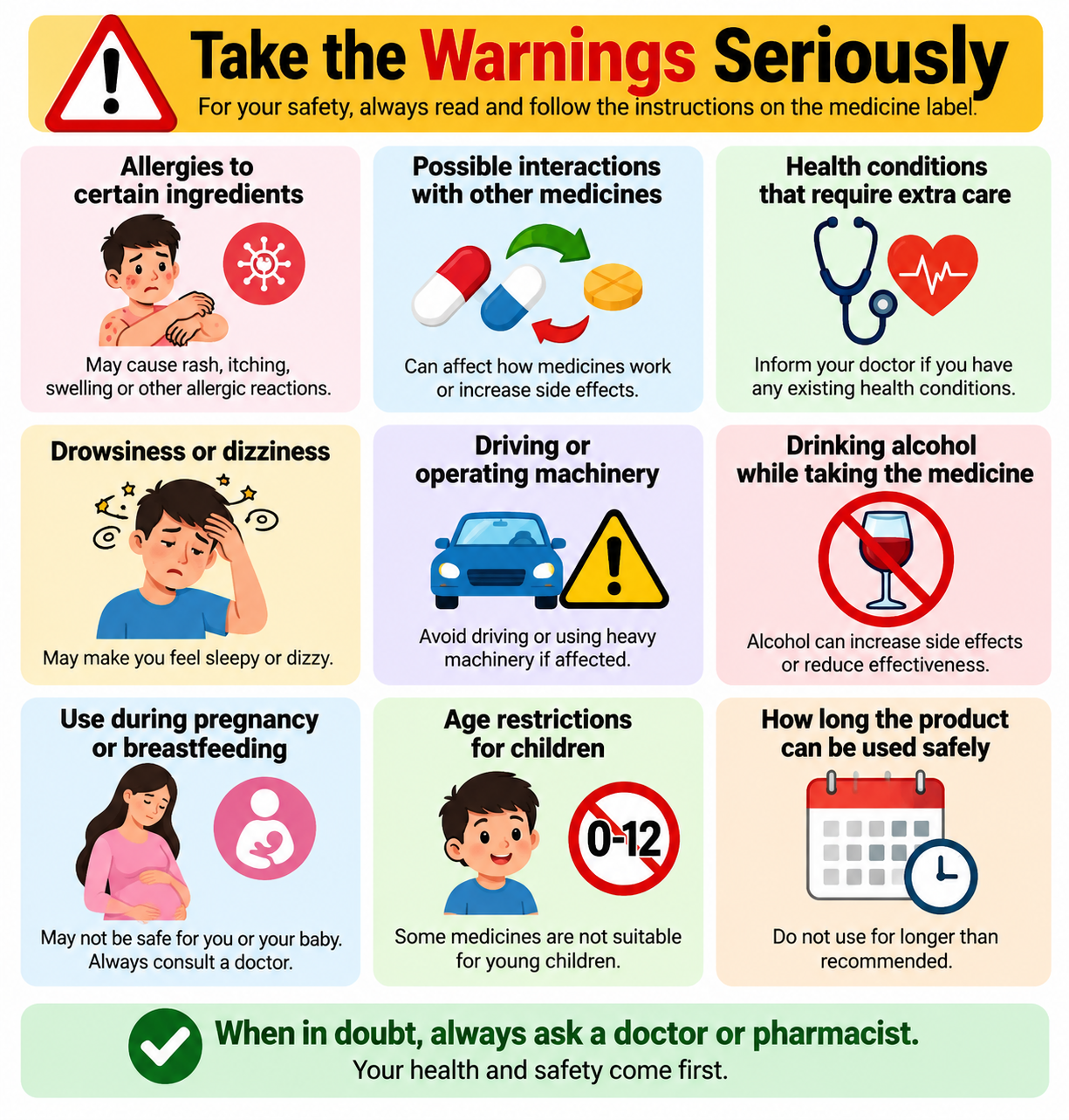
Warnings are included to protect you. They explain when a medicine should not be used or when you should consult a healthcare professional first.
The label may warn you about:
- Allergies to certain ingredients.
- Possible interactions with other medicines.
- Health conditions that require extra care.
- Drowsiness or dizziness.
- Driving or operating machinery.
- Drinking alcohol while taking the medicine.
- Use during pregnancy or breastfeeding.
- Age restrictions for children.
- How long the product can be used safely.
Never ignore a warning simply because you have taken the medicine before. Your health, other medicines or the product’s formulation may have changed.
If a medicine can cause drowsiness, wait until you know how it affects you before driving or performing any activity that requires concentration.
Look at the Possible Side Effects
Almost every medicine can cause side effects, although not everyone experiences them. The package leaflet will usually list common side effects as well as less common but more serious reactions.
Some mild effects may settle as your body adjusts to the medicine. However, you should contact a healthcare professional if a side effect is severe, continues for a long time or worries you.
Get urgent medical help if you experience symptoms of a serious allergic reaction, such as:
- Difficulty breathing.
- Swelling of the face, mouth, lips or throat.
- A severe or rapidly spreading rash.
- Sudden weakness, fainting or confusion.
Do not stop taking an important prescription medicine without speaking to a doctor unless you need emergency assistance.
Check the Expiry Date
Before using any medicine, look for its expiry date. It may be shown as “EXP” followed by a month and year.
A manufacturer sets this date based on how long the medicine is expected to maintain its quality when stored correctly. Once a medicine has expired, its safety, strength or effectiveness may no longer be guaranteed.
You should also examine the condition of the packaging. Avoid using the medicine if:
- The safety seal is broken.
- The bottle is leaking.
- The tablets have changed colour.
- The syrup smells or looks unusual.
- The packaging is damaged.
- The label is missing or unreadable.
When in doubt, show the product to a pharmacist instead of taking a risk.
Follow the Storage Instructions
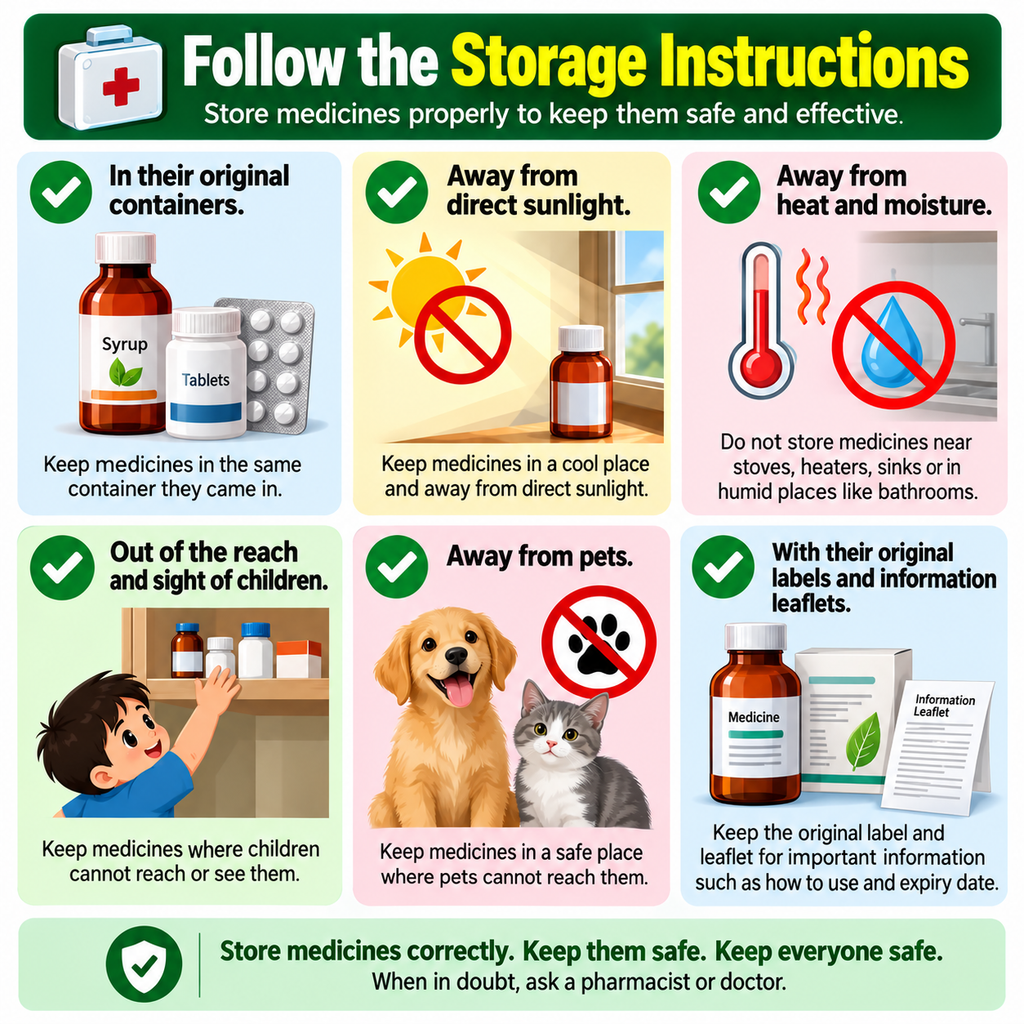
Medicines do not all have the same storage requirements. Some should be kept at room temperature, while others may need refrigeration.
Read the storage section and follow it carefully. In general, medicines should be kept:
- In their original containers.
- Away from direct sunlight.
- Away from heat and moisture.
- Out of the reach and sight of children.
- Away from pets.
- With their original labels and information leaflets.
A bathroom cabinet may seem like a convenient place, but the room can become warm and humid. Unless the label says otherwise, a cool and dry cupboard may be more suitable.
Do not put a medicine in the refrigerator unless its instructions specifically tell you to do so. Excessive cold or freezing can also damage certain products.
Notice Any Special Directions
Some products have special directions that can affect how well they work. These instructions are often short, so they are easy to overlook.
You may see directions such as:
- Shake well before use.
- Swallow the tablet whole.
- Dissolve it in water before taking it.
- Take it with food.
- Take it on an empty stomach.
- Apply it only to the affected area.
- Avoid direct sunlight.
- Use within a certain number of days after opening.
Follow these directions exactly. For instance, crushing a tablet marked “swallow whole” may change how quickly the medicine is released inside your body.
Check the Batch Number and Manufacturer
A medicine package generally includes the manufacturer’s details and a batch or lot number.
The batch number identifies a particular group of products made during the same manufacturing process. It can help identify the affected products if a company or health authority announces a recall.
Keep the medicine in its original package until you finish using it. This ensures that the name, strength, expiry date and batch details remain available.
Common Mistakes You Should Avoid
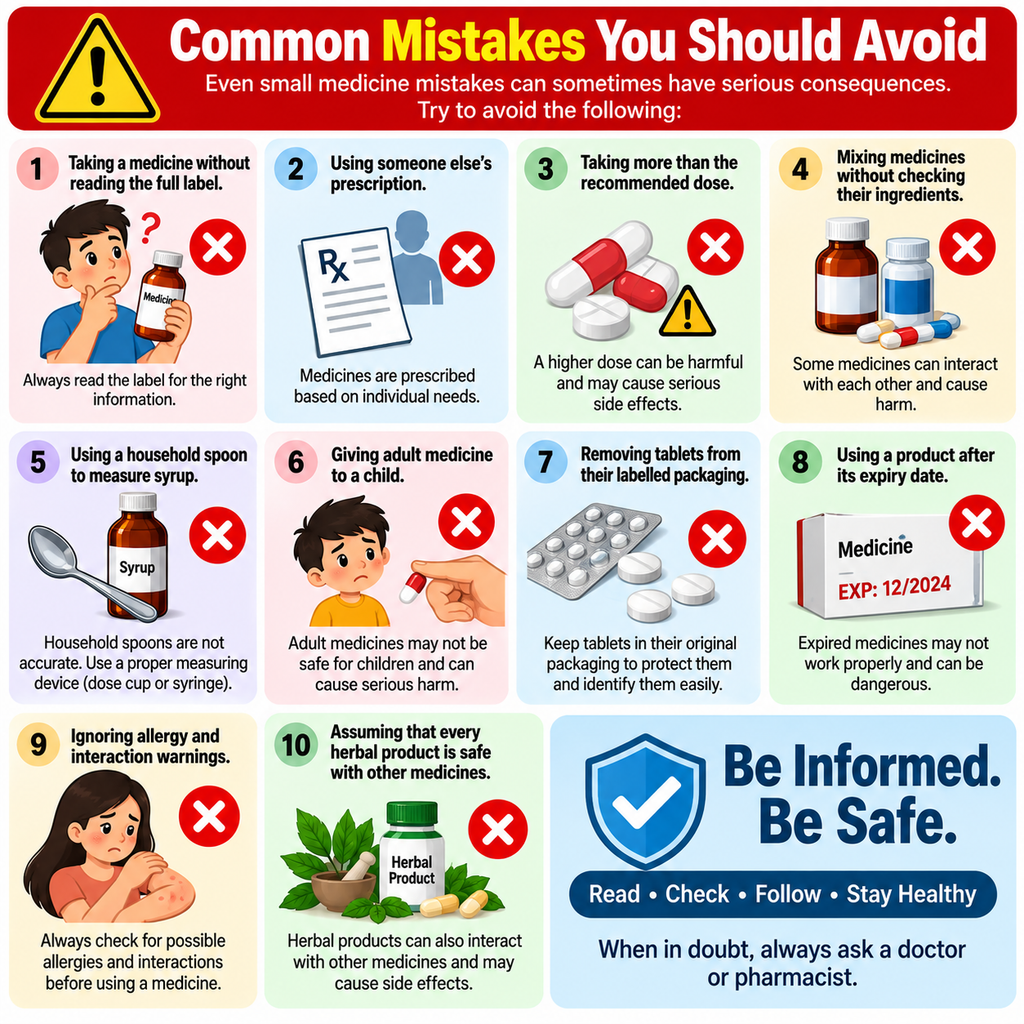
Even small medicine mistakes can sometimes have serious consequences. Try to avoid the following:
- Taking a medicine without reading the full label.
- Using someone else’s prescription.
- Taking more than the recommended dose.
- Mixing medicines without checking their ingredients.
- Using a household spoon to measure syrup.
- Giving adult medicine to a child.
- Removing tablets from their labelled packaging.
- Using a product after its expiry date.
- Ignoring allergy and interaction warnings.
- Assuming that every herbal product is safe with other medicines.
Herbal and natural products can also cause side effects or interact with prescribed medicines. Tell your doctor or pharmacist about any supplements or herbal products you use.
When Should You Speak to a Pharmacist?
Medicine labels are meant to provide guidance, but you are not expected to understand every medical term on your own.
Speak to a pharmacist or doctor if:
- You do not understand the dosage.
- You are taking several medicines.
- You have a long-term health condition.
- You have experienced a medicine allergy.
- You are pregnant or breastfeeding.
- You want to give medicine to a young child.
- The medicine looks different from usual.
- You are unsure whether two products can be taken together.
- Your symptoms are becoming worse.
It is always better to ask a question than to guess.
A Quick Check Before Taking Medicine
Before taking a dose, pause for a moment and check:
- Is this the correct medicine?
- Is it meant for me?
- What is the active ingredient?
- How much should I take?
- When should I take it?
- Are there any warnings?
- Could it interact with my other medicines?
- Is it still within its expiry date?
- Has it been stored correctly?
This quick check takes less than a minute, but it can prevent avoidable mistakes.
Final Thoughts
Learning how to read medicine labels can help you use medicines more confidently and responsibly. Make it a habit to check the name, active ingredient, dosage, warnings, expiry date and storage instructions every time.
Most importantly, never guess when something on the label is unclear. Ask a qualified doctor or pharmacist for help before using the medicine.
Disclaimer: This article is intended for general educational purposes only. It is not a substitute for medical diagnosis, treatment or personalised